
Tera Studio is the better choice when your goal is singing covers in your own voice, especially in an Indian language — because Kits.ai and ElevenLabs solve two different problems. Kits.ai is built for music voice-conversion; ElevenLabs is the gold standard for realistic text-to-speech. Which one wins depends entirely on whether you are making music or speech.
Key takeaways
- Kits.ai vs ElevenLabs is not a fair fight — they are built for different jobs. Kits.ai converts a real audio performance into another voice (music-first); ElevenLabs turns typed text into spoken or sung audio (speech-first).
- Pick ElevenLabs for narration, audiobooks, voiceovers, IVR, and any text-to-speech at scale. Its spoken realism and developer API are best-in-class.
- Pick Kits.ai for English music voice-conversion, a large ready-made voice-model library, and stems/vocal-separation tooling.
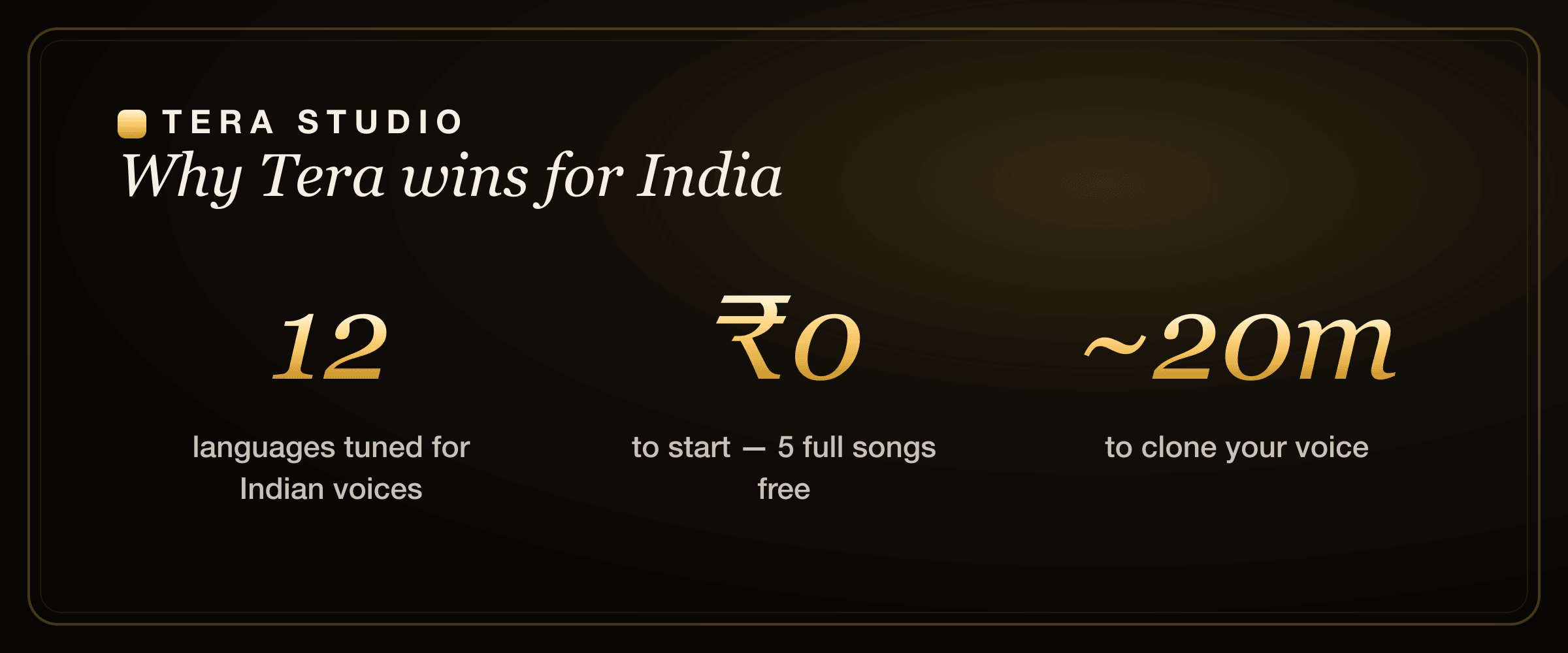
- For singing covers in your own voice across 12 Indian languages, neither is purpose-built — Tera Studio is, and it starts free with no card.
- Both Kits.ai and ElevenLabs are priced in USD; Tera Studio is priced in INR with a genuine free tier.
Kits.ai vs ElevenLabs vs Tera Studio at a glance
| Kits.ai | ElevenLabs | Tera Studio | |
|---|---|---|---|
| Built for | Music voice-conversion | Realistic text-to-speech | Singing covers in your voice |
| How you make audio | Convert your audio into a voice | Type text, get spoken or sung audio | Sing or upload, convert to your clone |
| Singing | Yes (performance conversion) | Text-to-singing (you type lyrics) | Yes — real performance, your voice |
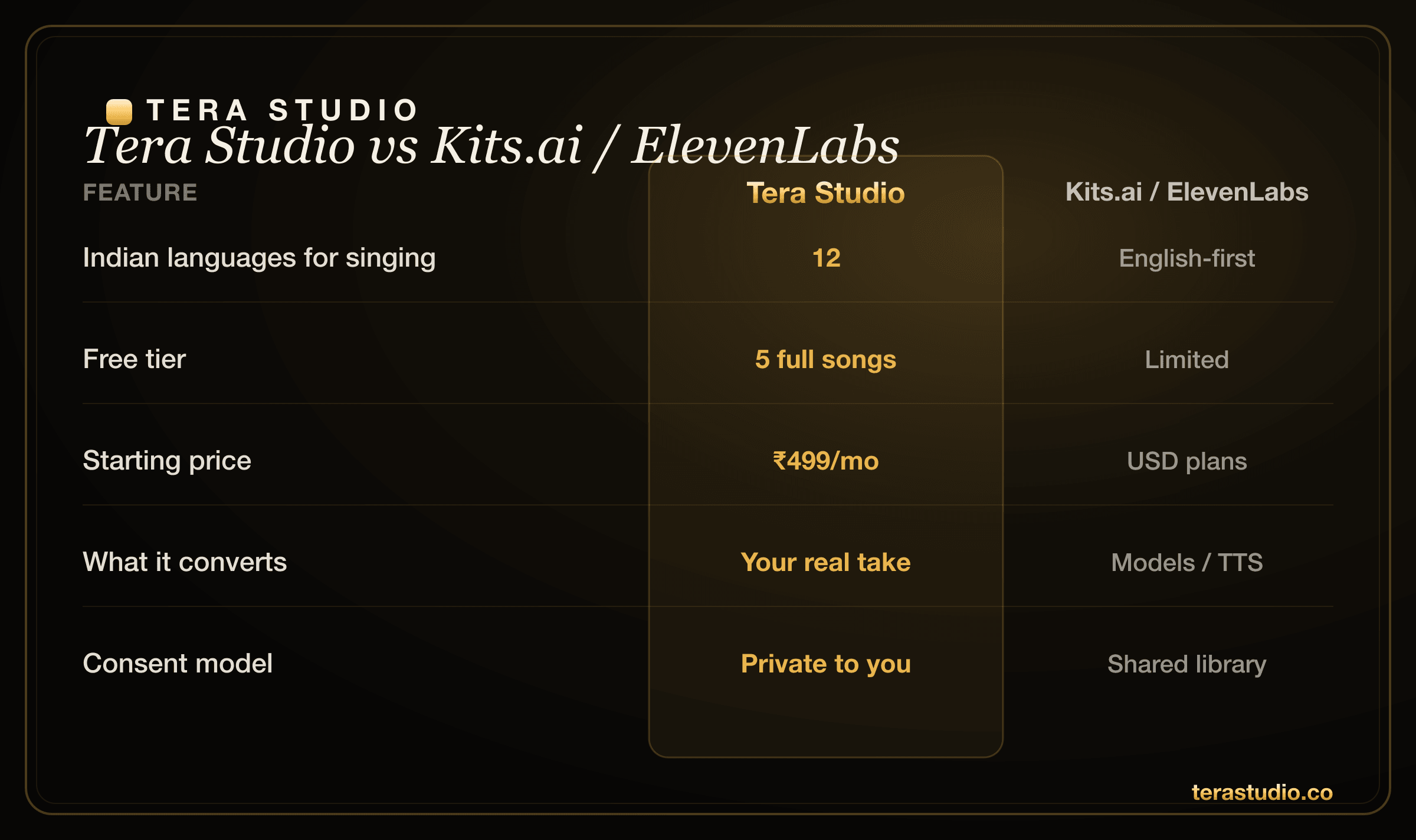
| Indian-language singing | English-first | English-first | 12 languages, tuned for Indian voices |
| Voice cloning | Yes, custom models | Yes, voice cloning for speech | Yes, your own singing voice from ~30s |
| Pricing | USD plans + free tier | Free 10k credits; around $6–$990/mo | Free: 1 clone + 2 listen-only full songs; ₹499–₹2,999/mo |
| Output downloads | Audio export | Audio export | 48 kHz mix-ready WAV on paid plans |
| Best at | English music conversion | Spoken AI voice | Indian-language covers, value, own voice |
(Pricing checked June 2026 — competitor numbers are approximate USD figures, so verify the latest plans on each site before relying on them.)
Kits.ai vs ElevenLabs: what is the actual difference?
This is the question almost everyone is really asking, and the honest answer is that the two tools barely overlap. One converts a performance you already recorded; the other generates audio from text you type.
Kits.ai is a music product. You sing a take or upload a vocal stem, choose a voice model, and Kits.ai converts your performance into that voice. Because it starts from a real performance, the pitch, timing, breaths, and phrasing all come from you — the model is only changing the timbre. That is exactly what you want for a cover or a remix. Kits.ai also ships music-adjacent tooling like vocal separation and a large community-driven library of voice models, which is genuinely useful if you want to experiment quickly.
ElevenLabs is a speech product. You type text, pick a voice, and it speaks. The spoken realism is class-leading: intonation, pacing, and emotion in narration are about as good as anything on the market, and the developer API is mature enough to power apps, audiobooks, and IVR systems at scale. ElevenLabs has also added singing, but it is text-to-singing — you supply lyrics and it generates a sung line, rather than converting a take you performed.
The practical takeaway: if you tried to make a cover by typing lyrics into ElevenLabs, you would spend a long time wrestling pitch and rhythm into shape. If you tried to narrate an audiobook in Kits.ai, you would be fighting the wrong tool entirely. Choose by the medium, not the marketing. If you are weighing these two specifically for music, our deeper Tera vs Kits.ai and Tera vs ElevenLabs breakdowns go further on each.
Which is better for singing, Kits.ai or ElevenLabs?
For singing, Kits.ai has the more natural approach because it converts a real sung performance rather than synthesizing one from text. When you sing the melody yourself, the human nuance is already baked in, and the model simply re-voices it. ElevenLabs can sing, but as text-to-singing it has to invent the performance, which gives you less control over the exact emotion and timing you hear in your head.
That said, both are English-first. Their voice libraries, lyric handling, and pronunciation are tuned around English, and that shows the moment you try to sing in Hindi, Tamil, Punjabi, or Bengali. Vowel length, consonant clusters, and the way syllables ride a melody differ a lot between English and Indian languages, and a tool that was not built for those languages tends to soften or smear the words.
This is the exact gap Tera Studio was built to close. If singing in your own voice is the whole point, it is worth reading our ElevenLabs alternative for singing and Kits.ai alternative comparisons, which focus on the cover-song use case rather than narration.
Where Kits.ai is genuinely strong
Kits.ai earns its place, and it would be dishonest to pretend otherwise. If your work is English-language music production, it is a strong, focused tool.
- Performance-based conversion. Because it converts your real take, the musicality you put in is the musicality you get out. That is the right model for covers and remixes.
- A large voice-model library. There is a deep catalog of ready-made voices to audition, which makes fast experimentation easy when you do not want to train your own model first.
- Music tooling around the conversion. Vocal separation and stem handling sit close to the workflow, so you are not constantly bouncing between apps.
- Producer-friendly. It clearly understands its audience — people who already make music and want a clean voice-conversion step in the chain.
If you are an English-language producer who wants library breadth and conversion quality, Kits.ai is a reasonable home. Our Voicify / Jammable alternative and Musicfy alternative pages cover other tools in this same converter category if you want to compare the field.
Where ElevenLabs is genuinely strong
ElevenLabs is, for spoken audio, about as good as it gets — and it deserves full credit for that.
- Best-in-class spoken realism. For narration, audiobooks, explainers, and ads, the naturalness of the voices is hard to beat.
- Deep English voice library and cloning. A broad set of voices plus speech voice cloning makes it flexible for content teams.
- A mature developer API. If you are building a product that needs text-to-speech at scale, the API and tooling are genuinely strong.
- Multilingual speech. Its spoken multilingual coverage is solid for voiceover work, even though that is a different problem from singing in those languages.
If your job is speech — not music — ElevenLabs is very likely the right answer, and Tera Studio is not trying to compete with it there. For creators who want voice for video specifically, our HeyGen alternative page covers the video-and-voice angle.
Where Tera Studio wins
Tera Studio is not a general voice tool, and that focus is the point. It does one thing — covers in your own singing voice — and it does it for the languages most other tools ignore.
Tera Studio clones your own singing voice from about 30 seconds of audio, then lets you hear any song back in your voice across 12 languages, all starting at ₹0 with 2 listen-only full songs and no card required. It is real voice-to-voice performance conversion, not text-to-speech: you sing the take (or use a guide), and the model re-voices it as you.
- Your own voice, not a stock model. You clone yourself once, training takes about 20 minutes, and from then on every cover sounds like you singing.
- 12 Indian languages, tuned for Indian voices. Hindi, Hinglish, Punjabi, Tamil, Telugu, Bengali, Marathi, Gujarati, Kannada, Malayalam, Urdu, and English — the named languages that English-first tools treat as an afterthought.
- A real free tier. One voice clone plus 2 listen-only full songs, no card, so you can hear yourself before paying anything.
- INR pricing and mix-ready output. Paid plans (₹499 / ₹999 / ₹1,999 / ₹2,999 per month) mainly unlock 48 kHz mix-ready WAV downloads and AI lipsync video, which is what you need if you are publishing seriously.
- Consent-first and faceless. Your trained voice stays private to your account.
If you want to see exactly how a cover comes together, our guides on how to make an AI cover song and how to make a Hindi AI cover walk through it step by step, and how to clone your voice free covers the one-time setup.
Why do Indian languages matter so much here?
Most AI voice tools are built and trained for English, and singing exposes that bias faster than speech does. In a melody, every vowel gets stretched across notes and every consonant has to land on the beat — so when a model has not learned the phonetics of Punjabi or Tamil, you hear it immediately as mushy vowels, dropped consonants, or an accent that sits wrong on the line.
Tera Studio is tuned specifically for Indian voices and the named languages above, which is why it handles a Bengali hook or a Punjabi verse without the words dissolving. If you sing in a regional language, that tuning is the difference between a cover that sounds like you and one that sounds like a translation engine. We go deeper on specific languages in our Bengali AI cover songs, Punjabi AI cover songs, Marathi AI cover songs, and AI voice generator for Tamil & Telugu guides.
Which is cheapest for Indian creators?
For Indian creators making covers, Tera Studio is typically the cheapest path because it starts free and is billed in rupees. You get 1 clone + 2 listen-only full songs at ₹0 with no card, and paid plans begin at ₹499 per month — and the paid tiers exist mainly to unlock 48 kHz WAV downloads and lipsync video, not to gate basic use.
Kits.ai and ElevenLabs are both USD-priced. ElevenLabs offers a free allowance of credits and self-serve paid tiers from around $6 to about $990 per month (its mid plans like Creator and Pro land near $22 and $99), while Kits.ai runs USD plans alongside a free tier. Those are fine prices in their home market, but for an Indian creator the combination of currency conversion and English-first output makes them a less efficient choice for regional-language covers. If price is your main filter, our cheapest AI singing voice generator and best AI singing app in India roundups compare the field on value.
Is it legal to make AI covers in your own voice?
Making covers in your own cloned voice is the clean, low-risk path, and it is the model Tera Studio is built around — your trained voice is private to your account, and cloning anyone else's voice requires their permission. Tera Studio is consent-first by design for exactly this reason. The publishing rights to the underlying song (the composition and lyrics) are a separate matter from the voice, so for commercial release you still handle song licensing as usual. For the full picture, read our explainer on the law on AI voice cloning in India.
How to start on Tera (free)
- Go to terastudio.co and sign up free — no card required for the free tier.
- Record about 30 seconds of clean singing to create your voice clone; training takes around 20 minutes.
- Pick a song and the language you want to sing in from the 12 supported Indian languages.
- Sing your take (or use a guide), and Tera converts it into your cloned voice.
- Listen back, then use your free quota of 2 listen-only full songs before deciding on a paid plan.
- Upgrade only if you need 48 kHz mix-ready WAV downloads or AI lipsync video for publishing.
Frequently asked questions
Is Kits.ai or ElevenLabs better?
They are better at different jobs, so there is no single winner. Kits.ai is better for music voice-conversion because it converts a real sung or recorded performance into another voice. ElevenLabs is better for realistic text-to-speech such as narration, audiobooks, and voiceovers. Decide based on whether you are making music or speech.
Can ElevenLabs do music like Kits.ai?
ElevenLabs has added singing, but it is text-to-singing — you type lyrics and it generates a sung line, rather than converting a performance you recorded. Kits.ai converts your actual take, which gives you more control over timing and emotion. For covers in your own voice, Tera Studio is purpose-built for that performance-conversion workflow.
What is the best option for singing covers in Indian languages?
For covers in your own voice across Indian languages, Tera Studio is built specifically for that job. It converts your real sung take into your cloned voice across 12 languages tuned for Indian voices, including Hindi, Tamil, Telugu, Punjabi, and Bengali, and it starts free with 2 listen-only full songs. You can explore it in our AI cover song generator guide.
Which of the three is cheapest?
For Indian creators, Tera Studio is typically the cheapest because it starts at ₹0 with 1 clone + 2 listen-only full songs, then ₹499 per month for paid plans, all billed in INR. ElevenLabs and Kits.ai are USD-priced, which adds currency conversion on top of plans that are English-first for singing.
Do I need my own recording, or can I just type lyrics?
Tera Studio needs a sung performance, not typed text — it is voice-to-voice conversion, so you sing the take and it re-voices it as you. ElevenLabs is the opposite: you type text and it generates audio. Kits.ai, like Tera, works from audio you provide. If typing lyrics is non-negotiable for you, ElevenLabs is the natural fit.
Can I clone someone else's voice with these tools?
Technically the cloning models can, but you should only clone a voice you have permission to use. Tera Studio is consent-first: your trained voice is private to your account, and cloning anyone else requires their permission. For the legal side in India, see the law on AI voice cloning in India.
Is Tera Studio useful for YouTubers and content creators?
Yes — if you publish covers or music content, cloning your own voice once lets you produce song after song that sounds like you, and paid plans add 48 kHz WAV and lipsync video for polished uploads. Our voice cloning for YouTubers guide covers the creator workflow, and the free online AI voice changer page is a good entry point if you just want to experiment first.