
AI voice cloning is legal in India when you clone your own voice, or a voice you have explicit permission to use. What lands people in trouble is cloning someone else's voice without consent, which can breach their personality rights and India's 2026 synthetic-media rules. Fake celebrity endorsements and deceptive deepfakes are the line you never cross.
This guide explains the rules in plain English — what Indian courts have actually ruled, what the new 2026 IT Rules require, and exactly how to create AI covers without legal worry.
This is general information, not legal advice. Laws change and facts matter — for anything commercial or contentious, talk to a qualified lawyer.
Key takeaways
- Cloning your own voice is the clearly legal path. It is your voice, you consented, and nobody's personality rights are touched.
- Consent is the whole game. Cloning anyone else needs their permission in writing — keep proof.
- Indian courts protect a person's voice under personality (publicity) rights, from the 2023 Anil Kapoor injunction through the 2025 wave of celebrity protection orders.
- The 2026 IT Rules require platforms to label AI-generated content, embed traceable metadata, and take down unlawful synthetic media fast.
- Song copyright is separate from voice rights — a cover can still need permission for the underlying composition depending on how you publish it.
Is AI voice cloning legal in India right now?
There is no single statute in India titled "voice cloning law." Instead, the legality of any clone turns on two questions, and almost every real situation collapses into them.
The first question is whose voice is it? Your own voice, or a voice whose owner has given you permission, is fine. Someone else's voice without permission is where risk begins. The second question is what are you using it for? Personal creativity, covers in your own voice, clearly labelled parody, or properly consented commercial work sit at the low-risk end. Deception, fake endorsements, fraud, harassment, or anything sexual or defamatory is illegal, full stop, regardless of consent.
If your honest answer is "my own voice, for my own covers," you are on solid ground. That is precisely the use case Tera Studio is built around, and it is why the safest way to start making music with AI is to clone your own voice for free rather than chasing someone else's.
What have Indian courts said about cloning a voice?
India protects a person's voice through personality rights (also called publicity rights), drawing on a blend of privacy, defamation, tort, and intellectual-property law rather than one dedicated act. The direction of travel is now unmistakable.
In a landmark 2023 case, the Delhi High Court restrained the unauthorised use of actor Anil Kapoor's name, image, likeness, and voice — even his well-known catchphrase — in AI-generated content and merchandise, whether or not money changed hands. The court treated his identity as something with legal and commercial value that others cannot freely exploit.
Through 2025, a wave of public figures — including names such as Hrithik Roshan, Aishwarya Rai, Akshay Kumar, and others — obtained protective orders after discovering AI-generated clips of them saying or endorsing things they never did. Courts have framed unauthorised use of a person's identifiable features, voice included, as misappropriation, passing off, and in some cases defamation.
The practical translation is simple: a recognisable voice carries legal weight in India, and using one without consent can be actionable. That is the core reason responsible tools — and responsible creators — start from consent.
What do the 2026 IT Rules say about AI voices and deepfakes?
Alongside the courts, India tightened platform-level rules. The IT (Intermediary Guidelines and Digital Media Ethics Code) Amendment Rules, 2026 — notified on 10 February 2026 and in force from 20 February 2026 — introduced the concept of "synthetically generated information" (SGI), which expressly covers AI-cloned voices and deepfakes.
In broad strokes, the rules push platforms to do three things. First, label synthetic or AI-generated content so audiences know what they are hearing. Second, embed traceable metadata so synthetic media can be identified later. Third, take down unlawful synthetic content quickly — with sharply compressed timelines, as little as 2–3 hours for the most serious categories such as content covered by a court order or government direction and non-consensual sexual or intimate deepfakes. (Reported figures vary slightly by source and by which rule maps to which window, so treat the exact hours as indicative and check the Gazette text for specifics.)
The rules aim their teeth squarely at harmful uses: deception, fraud, impersonation, sexual content, and election interference. Making an honest cover of a song in your own voice, clearly understood as a personal creation, is not the behaviour these rules were written to stop. If you are simply learning how to make an AI cover song in your own voice, you are nowhere near the harmful conduct the rules target.
Is it legal to make an AI cover song in India?
This is the question most people actually arrive with, so it deserves a direct answer. Using your own voice to sing a cover is legal. The performance is yours, the voice is yours, and no one's personality rights are involved.
There is a second layer worth understanding, though, because it trips people up. The song itself is separate from your voice. A composition has its own copyright (the melody and lyrics), and a commercially released recording has its own rights too. Singing a cover in your own voice does not raise voice-rights issues, but how and where you publish that cover can still touch the underlying music rights — the same way a human busking a Bollywood hit and a label releasing it commercially are treated very differently.
For most creators making covers for fun, learning, or building an audience, this sits in the same well-worn territory as any human cover. If you plan to monetise heavily or release commercially, that is the moment to look into mechanical or sync permissions for the composition. The voice-cloning part — done in your own voice — is the easy, legal half. Creators publishing to YouTube in particular should read our notes on voice cloning for YouTubers to handle disclosure and platform rules cleanly.
Can I clone a celebrity or a famous singer's voice?
Not without their permission. This is the single riskiest thing people try, and it is exactly what Indian courts have moved to stop. Cloning a celebrity's or playback singer's voice — especially to imply an endorsement, to profit off their identity, or to make it sound like they said something they did not — squarely engages personality rights and likely amounts to passing off.
The fact that a voice is "famous" does not make it free to use; if anything, the opposite is true, because a recognisable voice has more commercial value to protect. A fan making a private clone for personal listening occupies a grayer, lower-profile space, but the moment that clone is published, monetised, or used to mislead, it becomes genuinely risky. The clean alternative is the one Tera is built for: sing the song yourself, in your own cloned voice, across 12 Indian languages — no one else's identity required.
Do I have to disclose that a voice is AI-generated?
Increasingly, yes. India's 2026 IT Rules push platforms toward labelling and traceable metadata on synthetic media, and several major platforms now ask creators to flag AI-generated or significantly AI-altered content at upload. Beyond the letter of the rules, disclosure is simply good practice: it protects you, sets honest expectations with your audience, and keeps you on the right side of fast-moving norms.
A short, plain line such as "AI cover — sung in my own AI-cloned voice" does the job. It signals the content is synthetic, makes clear no one is being impersonated, and removes any suggestion of deception — which is the thing both the courts and the rules care most about.
What's actually allowed? A plain-English risk table
Here is a practical summary of where common use cases fall. This is general guidance, not legal advice, but it maps closely to how Indian courts and the 2026 rules treat each situation.
| Use case | Risk level | Why |
|---|---|---|
| Clone your own voice for covers | Low | It's your voice; you consented |
| Clone a friend's or artist's voice with written consent | Low–Medium | Consent is the key; keep proof |
| Clearly-labelled parody, no deception, no profit off their identity | Medium | Context and labelling matter |
| Clone a celebrity's voice for a fake endorsement | High / illegal | Violates personality rights; likely passing off |
| Any voice used to deceive, defraud, or harass | Illegal | Squarely prohibited |
| Non-consensual intimate or sexual deepfake | Illegal | Among the fastest-takedown categories |
The pattern is consistent: your own voice plus honest intent equals low risk; someone else's voice plus deception equals illegal. Everything in between is decided by consent and context.
How to stay on the right side and still create freely
Staying compliant does not mean creating less. It means a few simple habits that keep your work firmly in the legal zone while you make as much music as you like.
Default to your own voice — the simplest safe path is cloning yourself, which is also the most rewarding because the result actually sounds like you. If you ever clone someone else, get their consent in writing first and keep it on file. Never impersonate anyone for endorsements or to deceive; "celebrity says buy this" is the textbook violation. Disclose AI when it is not obvious, since labelling is now the norm and increasingly required. And remember that voice rights and music rights are separate — a cover may still need the underlying composition's permissions depending on how you publish it. Whether you are making a Hindi AI cover, a Punjabi AI cover, or a Bengali AI cover, the same simple rules apply.
How Tera Studio is built for this
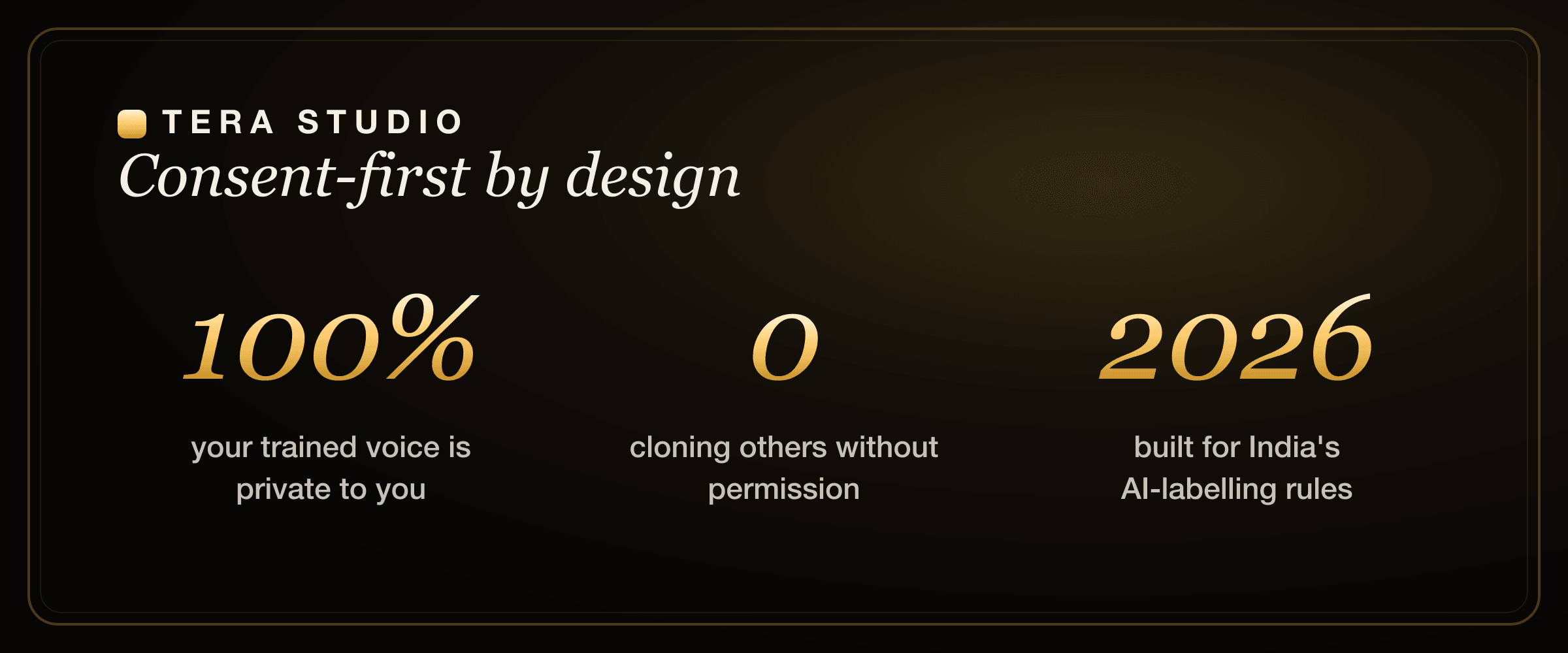
Tera Studio is consent-first by design, which lines up with exactly where Indian law is heading. Your trained voice is private to your account — nobody else can select it, use it, or even hear it. Cloning any voice requires the owner's permission, because the product is built around consent rather than scraping public figures. Disclosure and likeness consent are part of how we expect the tool to be used.
Tera Studio clones your singing voice from around 30 seconds of audio, trains it in roughly 20 minutes, and then lets you sing any song back in your own voice across 12 Indian languages — for ₹0 on the free tier, with 1 clone + 2 listen-only full songs included and no card required. That default workflow — clone yourself, keep it private, make covers — sits comfortably on the safe side of the line, and it is why so many creators choose it over generic free online AI voice changer tools that were never tuned for Indian singing or built around consent.
None of this makes us your lawyer. But the safe, legal path and the Tera path happen to be the same path: your voice, your covers, kept private. For the legal grounding behind all of this, see our full explainer on the law on AI voice cloning in India — and when in doubt about anything commercial, consult a qualified lawyer.
How to start on Tera (free)
- Go to terastudio.co and sign up free — no credit card needed.
- Record around 30 seconds of clean singing audio in a quiet room.
- Let Tera train your voice; it takes about 20 minutes.
- Pick a song and hear it back in your own AI-cloned voice, in any of 12 Indian languages.
- Upgrade only if you want 48 kHz mix-ready WAV downloads and AI lipsync video — paid plans start at ₹499 per month.
Frequently asked questions
Is AI voice cloning legal in India?
Cloning your own voice, or a voice you have explicit permission to use, is legal in India. Cloning someone else's voice without consent can violate their personality rights and, depending on use, breach India's 2026 synthetic-media rules. The deciding factors are whose voice it is and whether your intent is honest.
Is it legal to make an AI cover of a song in my own voice?
Using your own voice is fine — the performance and the voice are both yours. Note that the song itself may carry separate copyright in the composition and the original recording, so how you publish a cover can still require the relevant music permissions, especially for heavy monetisation or commercial release.
Can I clone a celebrity or playback singer's voice?
Not without permission. Indian courts have repeatedly protected celebrities' voices under personality rights, from the 2023 Anil Kapoor injunction onward. Cloning them without consent — especially for endorsements, profit, or to imply they said something — is legally risky. Singing the song yourself in your own cloned voice avoids the problem entirely.
Do I have to disclose that a voice is AI-generated?
Increasingly, yes. India's 2026 IT Rules push for labelling and traceable metadata on synthetic media, and major platforms now ask creators to flag AI-generated content at upload. A short line such as "AI cover in my own cloned voice" satisfies both the rules and good practice.
What are the 2026 IT Rules on synthetic media?
The IT (Intermediary Guidelines and Digital Media Ethics Code) Amendment Rules, 2026 — in force from 20 February 2026 — define "synthetically generated information," which includes AI-cloned voices and deepfakes. They require platforms to label such content, embed traceable metadata, and take down unlawful synthetic media quickly, with the tightest timelines (as little as 2–3 hours) for the most serious categories such as court-ordered removals and non-consensual sexual deepfakes.
Is cloning my own voice on Tera Studio legal?
Yes. Cloning your own voice is the clearly legal path, and Tera is consent-first by design: your trained voice is private to your account, and cloning anyone else requires their permission. The default workflow — clone yourself, keep it private, make covers — sits on the safe side of both the courts and the rules.
Does Tera Studio let people clone any voice?
No. Tera is consent-first. Your trained voice is private to your account, nobody else can use or even hear it, and cloning a voice requires the owner's permission. The product is built around your own voice, not scraping public figures.