
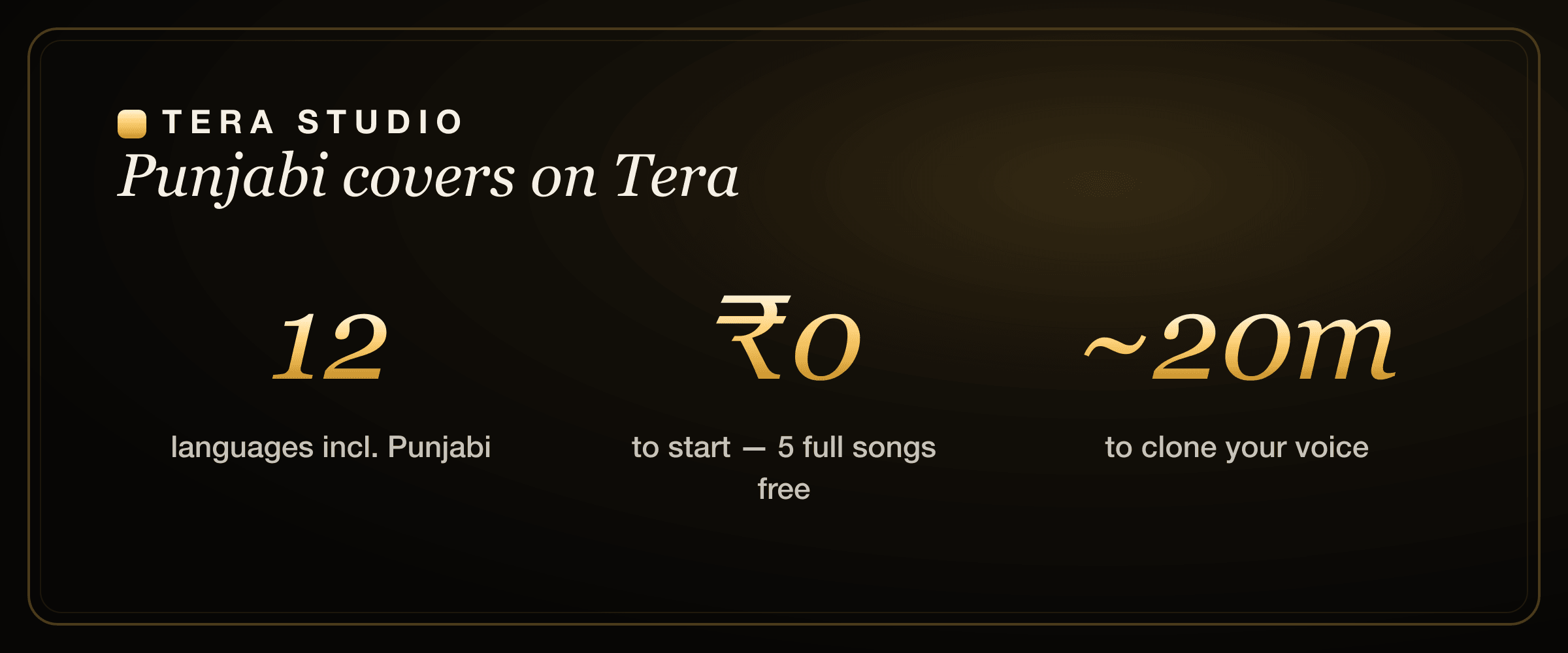
Tera Studio is the easiest way to make a Punjabi AI cover song in your own voice. You clone your voice from about 30 seconds of audio, then convert a Punjabi vocal you have the rights to into your own cloned voice — keeping the bounce, the hatke phrasing and the energy intact because Tera converts a real sung performance, not typed text. It is free to start, no card needed.
Key takeaways
- Tera Studio clones your singing voice from ~30 seconds of audio and trains in about 20 minutes, then lets you hear Punjabi songs back in your own voice.
- It is voice-to-voice performance conversion, not text-to-speech, so the groove, the dhol-driven rhythm and your ad-libs carry through.
- The free tier gives you 1 clone + 2 listen-only full songs with no credit card; paid plans start at ₹499/month and unlock 48 kHz mix-ready WAV downloads and AI lipsync video.
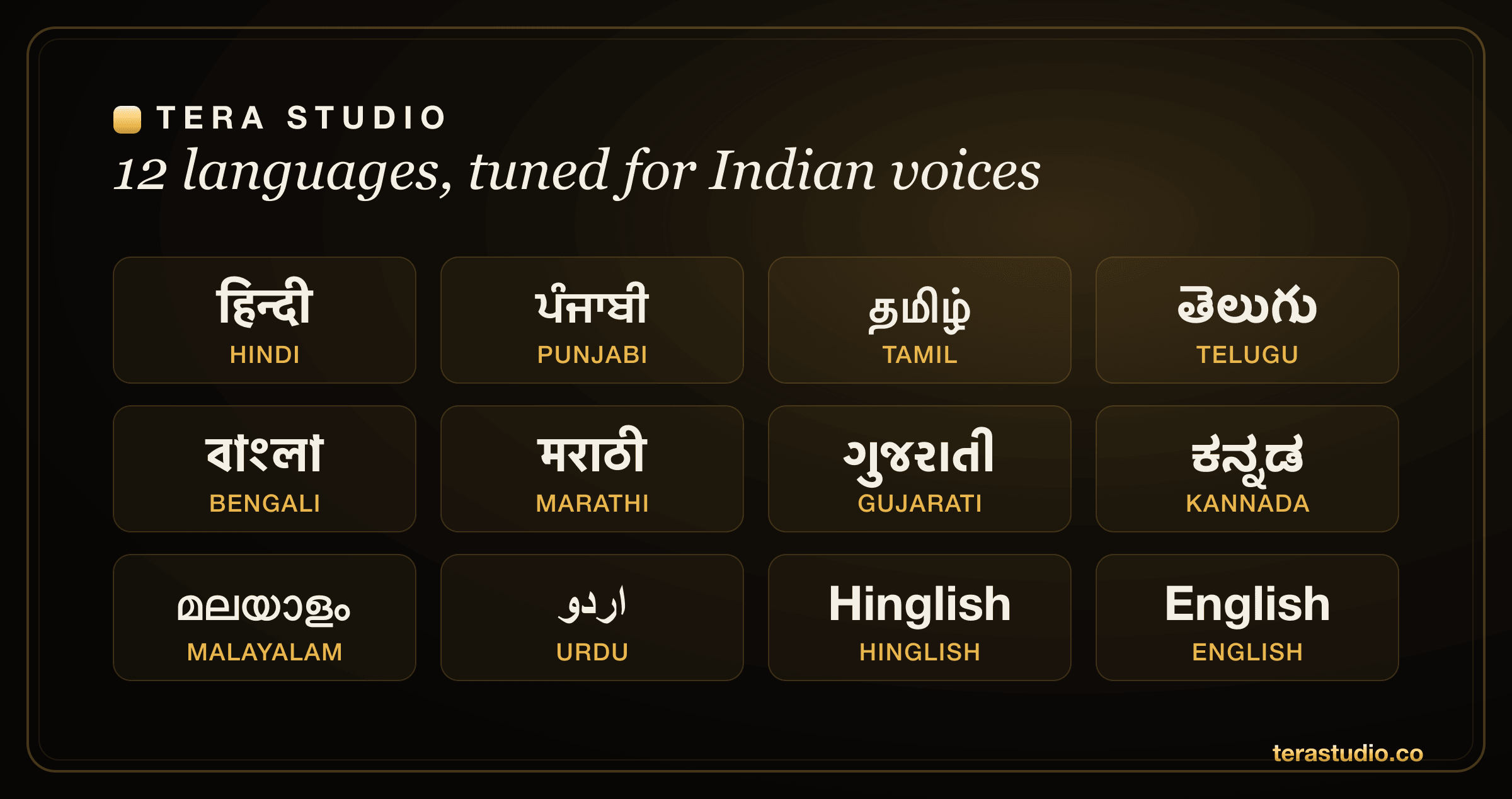
- One clone works across 12 Indian-tuned languages, so you can switch between Punjabi, Hindi, English and more without re-recording.
- Use your own voice freely; the underlying song may still carry its own copyright, so check the rules before you publish.
Why Punjabi singing needs a tool built for it
Punjabi music lives on rhythm and attitude. The groove sits on the dhol and the tumbi, syllables snap to the beat, and a huge part of the appeal is delivery — the swagger, the way a line lands half a beat ahead or behind the grid. A generic, English-first AI tool tends to sand all of that off. It quantizes the timing to a stiff grid, flattens the dynamics, and mangles the consonants that make Punjabi sound like Punjabi.
Tera Studio takes a different route. Instead of generating a vocal from typed lyrics, it converts a vocal you (or someone who has given permission) actually sang. That single design choice is what keeps the feel alive: the timing you performed is the timing that comes out, just rendered in your cloned voice.
What carries through when you convert a performance
- Rhythmic phrasing. Punjabi vocals ride the beat hard. Because Tera follows your sung take, the push-and-pull against the dhol survives rather than getting flattened to a click track.
- Pronunciation and Gurmukhi sounds. The retroflex and aspirated consonants — the difference between a soft and a hard sound — come from how you pronounce them. Tera reproduces your articulation instead of guessing phonemes from text.
- Energy and attitude. The dynamic swings, the grit on a belted line, the drop to a near-whisper before a hook — those are baked into your performance and travel through the conversion.
- Ad-libs and hooks. Those haaye, balle and improvised runs are character. They are part of the audio you feed in, so they come out the other side too.
This is the same engine behind every cover you can build with the AI cover song generator — the Punjabi result just benefits from voices tuned for Indian phonetics.
How do I make a Punjabi AI cover song?
The short version: clone your voice once, then convert any Punjabi vocal you have the rights to. Here is the full walk-through.
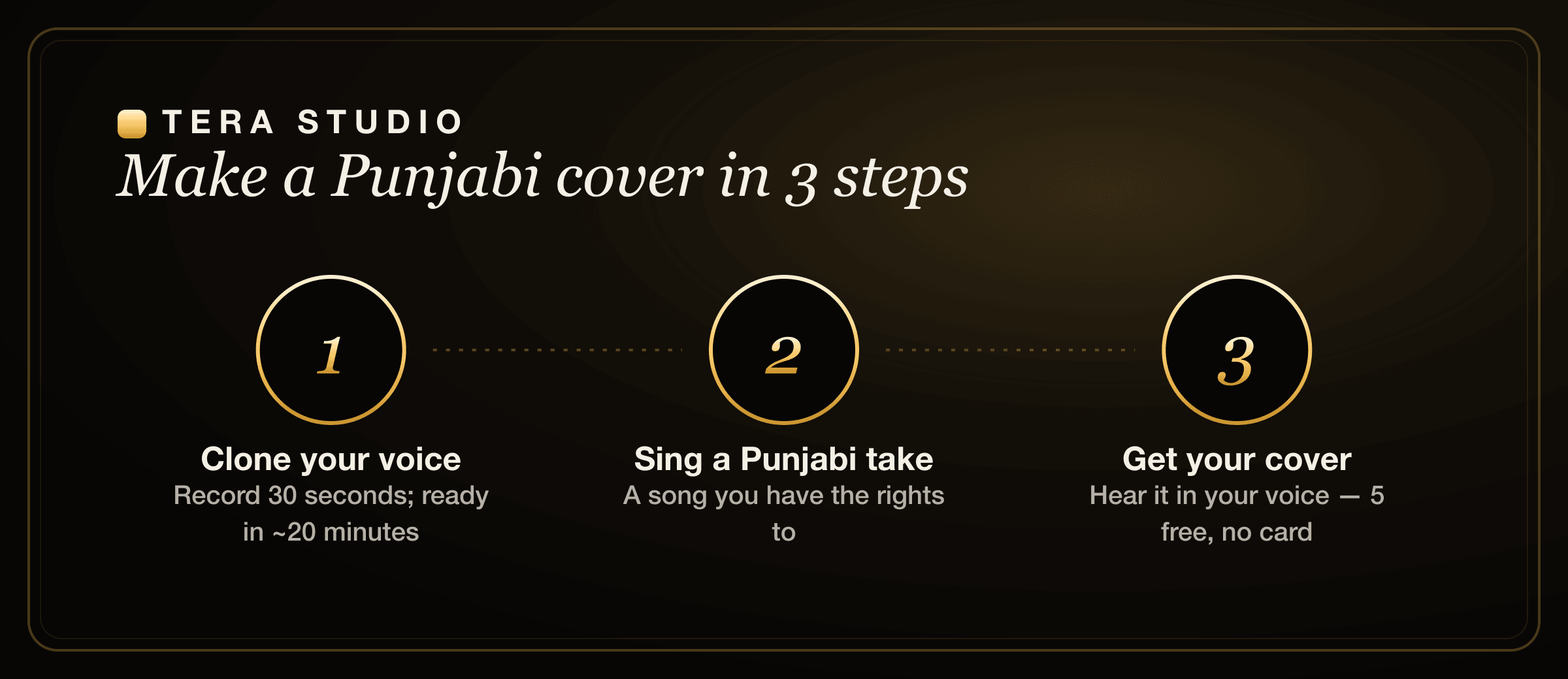
Step 1 — Sign up free and clone your voice
Create a free account at terastudio.co. Record about 30 seconds of clean singing — it can be in Punjabi, Hindi, English, or whatever you are comfortable with, because the voice transfers across languages. Training takes roughly 20 minutes, and you only do this once. If you want the deep dive on getting a clean clone, the guide on how to clone your voice free covers mic distance, room noise and take selection.
Step 2 — Choose and perform the Punjabi vocal
Pick a Punjabi vocal you have permission to use. The single biggest quality lever is to record your own take of the melody if you can. The more you perform the groove — leaning into the beat, keeping the ad-libs — the more the Punjabi feel survives the conversion. If you are starting from an existing acapella, make sure it is isolated and clean, with no instrumental bleed.
Step 3 — Convert to your cloned voice
Select your trained voice and run the conversion. Tera maps your performance onto your cloned voice and renders the result. Listen back on headphones first — small issues like sibilance or a harsh line are much easier to hear there than on laptop speakers.
Step 4 — Refine, then export the take that slaps
Try a couple of takes and keep the one with the best energy. On a paid plan (from ₹499/month) you can download a mix-ready 48 kHz WAV to drop into your DAW, or generate an AI lipsync video to post straight to Reels and YouTube Shorts. The free tier still lets you make and listen to 2 listen-only full songs end to end so you can decide before paying.
Tera Studio gives you a real Punjabi cover for ₹0 to start — 1 clone + 2 listen-only full songs, no credit card — and the entry paid plan is just ₹499/month.
Will it keep the Punjabi groove and phrasing?
Yes, and this is the whole point of using a performance-conversion tool instead of a text-to-song generator. When you type lyrics into a generator, the software invents a rhythm and an accent for you, and for Punjabi that usually means a stiff, English-leaning result. When you convert a real sung take, the rhythm, the swagger and the hatke phrasing are already in the audio — Tera just changes whose voice is singing it.
That difference is exactly why singers who care about feel prefer this approach. If you are weighing the broader category, the comparison of ElevenLabs alternatives for singing explains why text-driven voice AI struggles with sung Indian-language phrasing.
Singing in Punjabi: pronunciation and phrasing nuances
Punjabi sits comfortably in Tera's set of 12 Indian-tuned languages, but a few habits will make your covers noticeably better.
- Aspiration matters. Punjabi distinguishes aspirated and unaspirated consonants strongly. Sing them as you naturally would; do not over-soften them to sound "cleaner," because the crispness is part of the identity.
- Tone and pitch movement. Punjabi has tonal qualities that English does not. Perform the natural rise and fall of the line rather than singing it dead-flat, and the conversion will follow it.
- Ride the beat, do not fight it. Punjabi delivery often sits slightly ahead of or behind the grid for swagger. Lean into that when you record — it is what separates a cover that grooves from one that sounds robotic.
- Keep the ad-libs and hooks. The haaye, the oye, the little runs between lines are character. Leave them in your take; they convert with everything else.
- Mix Punjabi and Hinglish freely. A lot of modern Punjabi pop slides between Punjabi, Hindi and English in a single track. Because your clone works across all 12 languages, those switches are no problem.
If you also sing in other South Asian languages, the same voice carries over — see how the workflow looks for Bengali AI cover songs and Marathi AI cover songs, or start from a Hindi AI cover.
Common mistakes to avoid
- Noisy or inconsistent source audio. Background hum, fan noise and shifting mic distance all degrade both the clone and the conversion. Record in a quiet room at a steady distance.
- Singing it flat to "let the AI handle it." Tera preserves what you give it. A lifeless take in equals a lifeless cover out. Perform the groove.
- Using a vocal with instrumental bleed. Feed in an isolated vocal. Drums or synths leaking into the acapella confuse the conversion.
- Converting in an uncomfortable key. Pick a key where your performance is strong and confident; a strained take limits the result.
- Skipping the headphone check. Laptop speakers hide sibilance and harshness. Always audition on headphones before you export.
One clone, twelve languages
Your cloned voice is not locked to Punjabi. The same voice works across 12 languages tuned for Indian singers: Hindi, Hinglish, Punjabi, Tamil, Telugu, Bengali, Marathi, Gujarati, Kannada, Malayalam, Urdu and English. Clone once, cover anything — a Punjabi banger today, a Tamil melody tomorrow, an English ballad next week. That range is a big reason Tera shows up on shortlists for the best AI singing app in India and why it is a serious Kits.ai alternative for Indian-language work.
Is it legal to make a Punjabi AI cover?
Using your own voice is completely fine — your trained voice is private to your account, and cloning anyone else requires their permission. The thing to watch is the underlying song: the composition and original recording may carry their own copyright, so how you publish a cover can still need the music's rights cleared. When in doubt, read the law on AI voice cloning in India before you post commercially.
How to start on Tera (free)
- Go to terastudio.co and create a free account — no credit card required.
- Record about 30 seconds of clean singing to clone your voice; training finishes in roughly 20 minutes.
- Bring a Punjabi vocal you have the rights to, ideally a take you performed yourself.
- Select your cloned voice, run the conversion, and listen back on headphones.
- Choose the best take. Upgrade from ₹499/month only when you want 48 kHz WAV downloads or a lipsync video.
- Sign up free at terastudio.co/signup and make your first Punjabi cover today.
Frequently asked questions
How do I make a Punjabi AI cover song?
Clone your voice on Tera Studio from about 30 seconds of audio (it trains in roughly 20 minutes), then convert a Punjabi vocal you have the rights to into your cloned voice. Your first 2 listen-only full songs are free with no credit card.
Will it keep the Punjabi groove and phrasing?
Yes. Tera converts your real sung performance rather than generating from typed lyrics, so your rhythm, your dhol-driven timing, your energy and your ad-libs all carry through into your cloned voice.
Can I make a Punjabi AI cover for free?
Yes. The free tier includes 1 clone + 2 listen-only full songs with no credit card. Paid plans (from ₹499/month) mainly add 48 kHz mix-ready WAV downloads and AI lipsync video.
Do I need to sing in Punjabi to clone my voice?
No. Your voice clone works across all 12 languages, so you can train in Hindi, English or any language you are comfortable with and still make a Punjabi cover. The same clone also handles Tamil and Telugu.
How long does it take to clone my voice and get a cover?
Cloning needs only about 30 seconds of clean audio and trains in roughly 20 minutes. After that, each conversion takes a few minutes, so most people go from sign-up to a finished Punjabi cover in well under half an hour.
Can I turn my Punjabi cover into a video?
Yes. On a paid plan you can generate an AI lipsync video from your cover, ready to post to Reels, Shorts and YouTube. This makes Tera a practical HeyGen alternative for music creators who want both the voice and the video.
Is this better than a text-to-song generator like Suno?
For covers in your own voice, yes — text-to-song tools invent a singer and a rhythm for you, while Tera renders a real performance in your actual voice. If you want fully AI-generated original songs instead, see this Suno alternative comparison.